When a driveway gate starts dragging or the latch stops lining up, most people look at the gate. Often the real problem sits lower, in a post that has leaned, a footing that has shifted, or a sliding gate support that has fallen out of line. The gate is only as straight as what it hangs from or rides on.
This guide explains what driveway gate posts and footings do, why the hinge side matters most on swing gates, how sliding gates are supported differently, how automation and masonry columns change the picture, and what signs point to a structural problem. It reflects what our team at Lambert’s Ironworks sees designing, building, and installing driveway gates across Dallas Fort Worth.
What Do Driveway Gate Posts Actually Do?
Driveway gate posts and foundations hold the gate’s weight and keep it in line as it moves. On a swing gate, the hinge post carries the leaf and resists its pull, the latch or stop post keeps the closed gate aligned, and the footings hold both steady in the ground. On a sliding gate, the weight is carried by a ground track or by cantilever supports, with posts and foundations keeping everything aligned. If any part of that structure moves, the gate can sag, drag, or bind.
Why the Hinge Post Carries the Load
The Lever Effect of a Heavy Leaf
A swing gate hangs entirely off one side. The leaf’s weight sits out past the hinges, so it pulls the top of the hinge post toward the opening and pushes the bottom the other way. A longer or heavier leaf makes that pull stronger.
That’s why a gate hinge post needs more strength than a fence post of the same height. Picture two posts that look identical from the street. One holds a short walk gate; the other carries a wide iron leaf that swings several times a day. Only the second one is fighting a constant lever, and it’s the one that leans first if it’s undersized.
Steel gate posts are the usual choice for iron driveway gates, but material is only part of it. Size and wall thickness should come from the gate’s actual weight and width.
Footings Sized for the Gate
A post is only as steady as its footing. The gate post foundation has to resist that lever, and it has to suit the soil and drainage at your entrance. Ground that changes with wet and dry seasons, or water that pools at the post base, can let a footing shift over time.
This is why we start every project with a full site evaluation, a step covered in our guide on what to expect during the custom driveway gate installation process. When a site has slopes, uneven ground, or obstacles, we adjust the design and reinforce where needed before any metal is fabricated.
Sliding Gates Have Different Structural Needs
A sliding gate doesn’t hang from a hinge post, so the structure behind it works differently. What matters is a level, stable path for the gate to travel and solid support at each point where it bears weight.
Track-supported sliding gates roll on wheels along a track set in or on the driveway. The track and the concrete beneath it need to be level, well-drained, and solid enough to carry the gate without settling or cracking. If the track shifts or collects debris, the gate can bind or jump its path.
Cantilever sliding gates have no ground track across the opening. The gate rides on roller assemblies mounted to support posts beside the opening, with a counterbalance section extending behind them. Those support posts and their foundations carry much of the gate’s weight and need to stay aligned with each other. The design also needs enough clear space along the fence line for the gate to slide fully open.
Alignment matters on both types. Guide rollers at the top, the support posts, and the receiving post on the closing side all need to line up so the gate travels straight and closes cleanly.
Operator mounting is usually separate from the gate itself. A sliding gate operator typically sits on its own concrete pad beside the gate and drives it through a gear rack or chain attached to the gate. The pad’s position and level, and the rack’s alignment with the operator, affect how smoothly the system runs.
Because of these differences, the choice between a swing gate and a sliding gate affects the foundations, the driveway layout, and the space needed along the fence line. It’s best decided early, while those elements can still be planned around it.
How Automation Raises the Stakes
Operators mount in different ways depending on the system. On swing gates, an operator may connect between the gate and a post or column, mount to the post itself, or sit below ground at the hinge. On sliding gates, the operator usually sits on its own pad and drives the gate through a rack. Whatever the setup, the operator pushes and pulls on every cycle, and it relies on the gate traveling the same path each time.
If a post flexes, a footing shifts, or a track or pad settles, that path changes slightly. Limit and force settings that were tuned on day one can drift out of adjustment, and the operator works harder and may stop more often.
Pairing the gate, structure, and operator in one design avoids that. Our installation team sets up trusted operator brands with clean wiring and safety devices, then tests and tunes the full system before handoff, including how the gate moves on its posts or supports.

Masonry Columns and Pillars
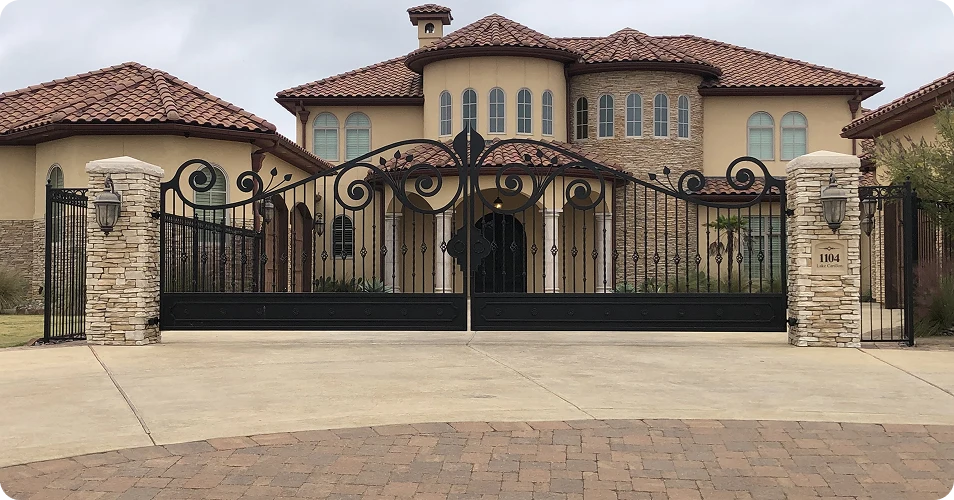
Brick and stone driveway gate columns look solid, but a column built only for looks may not be designed to carry a heavy gate. The hinges need anchoring into structure that can take the load, and an operator may need mounting points, conduit, or space built in. The column and the gate should be planned together.
On new builds, columns often go up long before the gate is ordered. Coordinating early with your builder and masonry contractor, as covered in our guide to planning a driveway gate during new home construction, lets the columns be built with what the hinges and operator need. Retrofitting anchors into a finished column is harder and more limited.
Plan the Structure With the Gate, Not After It
The most reliable gates are the ones where the posts, foundations, columns, and supports were designed alongside the gate itself. When the structure is treated as an afterthought, the gate ends up adapting to whatever is already in the ground.
For new construction, that coordination should happen before columns are built and before the driveway is poured. That’s the window to:
- Confirm the gate type, since swing and sliding gates need different foundations and layouts
- Plan footings, column reinforcement, and hinge or roller anchoring for the gate’s actual weight
- Set the location of an operator pad, track, or below-ground operator
- Run conduit for power, access controls, and safety devices before concrete and masonry are finished
At Lambert’s Ironworks, we work with builders and masonry contractors during this stage so the structure is ready for the gate before it arrives. It’s a big part of the difference between a gate that’s designed for the property and one that’s simply installed on it.
Signs That Point to a Structural Problem
Several structural and mechanical issues can produce similar symptoms, so these checks are indicators of where to look, not a diagnosis. On a swing gate:
- Hinge post out of plumb. A level held against the hinge post that shows a lean toward the opening may suggest the post or footing has moved.
- Hinge wear or looseness. Loose fasteners, worn pins, or hardware that has shifted can point to a hinge issue, especially if the post appears plumb.
- Frame out of square. If the two diagonals of the leaf measure differently, the frame may have racked.
On a sliding gate, signs can include a gate that drifts or binds along its travel, uneven wheel or roller wear, a track that has cracked or settled, or a gate that no longer meets its receiving post squarely.
These signs often overlap. A leaning post can also stress the hinges, and an out-of-square frame can make a post look like the problem. Adjusting hinges usually helps only when the post and frame are sound. Because the root cause isn’t always obvious, a professional inspection is the most reliable way to confirm what’s going on before deciding on a fix.

Is It the Post, the Hinge, or the Gate?
A sagging gate can come from three places, and each needs a different fix:
- Check the hinge post for plumb. Hold a level against it. If it leans toward the opening, the post or footing has moved.
- Check the hinges. Look for loose fasteners, worn pins, or hardware that has shifted on a plumb post.
- Check the gate frame. Measure both diagonals of the leaf. Unequal diagonals mean the frame itself has racked.
Most people adjust hinges first, which only works when the post and frame are sound. If the post leans, hinge adjustments just buy a little time.
Start From the Ground Up
The best support for a driveway gate is one designed for that gate’s weight, width, type, and operator, set in foundations that suit the site. That applies to swing gate posts and footings, and to the tracks, cantilever supports, and operator pads behind sliding gates. At Lambert’s Ironworks, every gate is measured to the opening and built for the property, with the posts, foundations, and supports planned alongside it. Get the foundation right, and the gate, hardware, and operator have something steady to work from.
Frequently Asked Questions
What size posts do driveway gates need?
It depends on the gate’s weight, width, height, and whether it’s automated. A wide iron leaf needs a much stronger post than a light walk gate, so sizing should come from the actual gate.
Can a 4x4 post support a gate?
A 4×4 wood post is common for small walk gates. A heavy iron driveway gate is a different load, so its posts should be sized to that gate.
What is the difference between a gate post and a fence post?
A fence post mostly holds panels upright. A gate post carries a moving, cantilevered load, and the hinge post takes the most stress, so it needs more strength and a stronger footing.
Do sliding gates need different foundations than swing gates?
Yes. A sliding gate needs a level, stable path, either a ground track on solid concrete or cantilever support posts with their own foundations, plus a pad for the operator in most cases. It also needs clear space along the fence line to open fully.
Can a sagging gate be fixed without replacing the post?
Sometimes. If the post is plumb and the frame is square, hinge work or adjustment may solve it. If the post leans or the footing has moved, the fix starts at the post.
Do I need a permit for new gate posts or columns?
Some Texas cities, counties, and HOAs have requirements for gate installations, columns, or electrical work. Requirements vary by address, so it’s worth checking before work begins. If you’d like help, Lambert’s Ironworks can assist with reviewing requirements and permitting when requested.