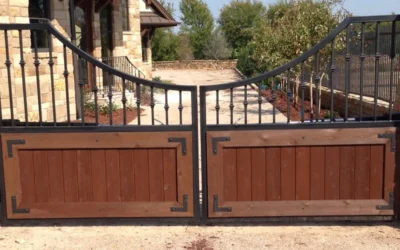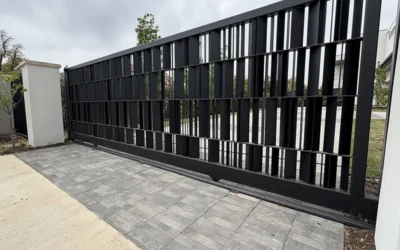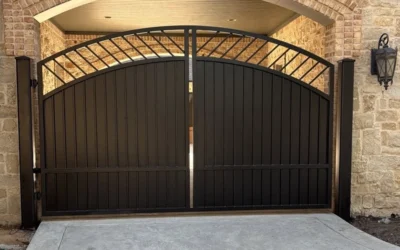
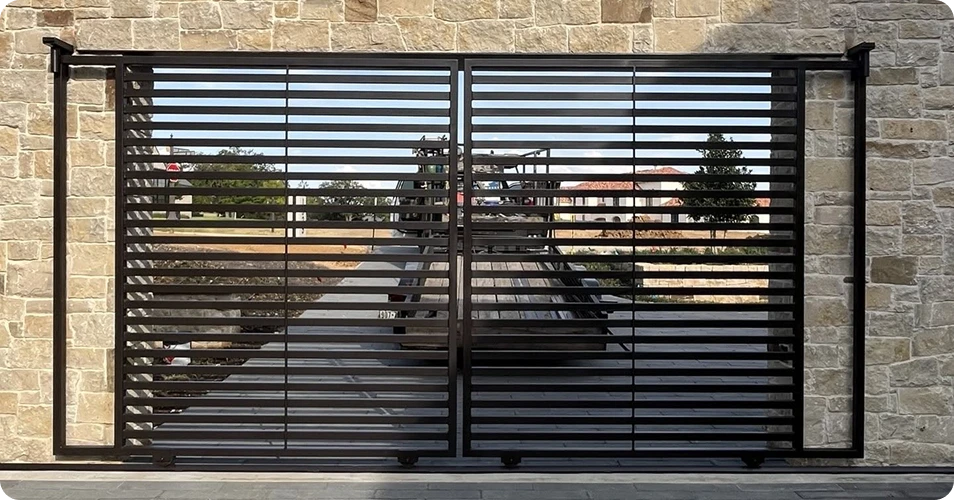
A flat driveway forgives almost any gate. Add a rise behind the gate line or a tilt across the entrance, and the same design can scrape, sag, or refuse to open. If you’re planning a gate on a sloped driveway, the grade should shape the design from the first sketch.
Below, you’ll learn how to read your slope, which fixes suit each grade, and what changes during installation, based on how our team at Lambert’s Ironworks evaluates terrain for custom driveway gates across Dallas Fort Worth.
How Does Driveway Slope Affect a Gate?
Driveway slope sets how much ground clearance a gate needs as it moves. A swing gate sweeps an arc, so any rise inside that arc can stop the leaf. A sliding gate travels in a straight line, so it needs a level path. Slope also changes post loads, operator placement, and how water moves toward the gate line.
Read Your Slope First: Three Kinds of Driveway Grade
The direction of the driveway grade matters more than how steep it feels.
| Grade type | What it looks like | What it means for the gate |
|---|---|---|
| Rising | Drive climbs from the street toward the house | An inward swing can hit the pavement |
| Falling | Drive drops from the street toward the house | Inward swings clear easily; runoff heads for the gate line |
| Cross-slope | Ground tilts side to side across the entrance | The closed gate meets uneven ground along its bottom edge |
Many lots combine two of these, which is why we measure the whole opening rather than a single point.
Design Solutions for a Gate on a Sloped Driveway
A slope rarely rules out a gate type. Single-swing, double-swing, or sliding configurations can all work once the design is matched to the grade, and our swing vs. sliding driveway gate guide covers how each one behaves on a real lot. The fixes below show how.
Swing Away From the Rise
The simplest fix for a swing gate on a slope is to swing it where the ground drops. On a falling drive, an inward swing clears with room to spare. On a rising drive, an outward swing can work, but only with enough setback that the leaves never reach the sidewalk or street.
Raised Hanging and Rising Gate Hinges
When the rise is modest, the leaf can be hung higher so its bottom clears the grade at full swing. Rising gate hinges help by lifting the gate slightly as it opens. The trade-off is a taller gap under the closed gate.
Raked Bottom Rails for Cross-Slopes
On a cross-slope, a gate with a square bottom leaves a wedge-shaped gap at the low end. Building the bottom rail to follow the grade closes that gap, so the gate sits tight to the ground when closed. The swing zone still needs a check, since the ground the leaf crosses may tilt as well.
Sliding and Cantilever Gates for Steep Drives
For a steep rise into the property, a slider is often the best gate for a sloped driveway, since nothing swings into the climb. A cantilever sliding gate rides on post-mounted rollers and never touches the drive, which also suits rough or uneven ground.
Most guides skip one catch. A sliding gate on a sloped driveway handles grade that runs up the drive, but grade that runs across its path is a different story. The panel travels level, so it must clear the highest point it passes, and a raked bottom only matches the ground in one position. On a strong cross-slope, a raked swing gate is often the cleaner answer.
What Slope Changes During Installation
Hinge posts on a slope carry an unevenly loaded leaf, so we reinforce where needed and set posts to the actual terrain. Operator placement depends on the swing path and the grade, so it’s planned before concrete is poured, one of the things to know before installing custom driveway gates that saves rework later. Safety devices are then aligned to the finished grade and tested before handoff.
Water deserves attention too. On a falling drive, runoff carries silt and gravel toward the gate line, and steel that stays wet wears its finish faster. Keeping sprinklers off the ironwork helps it last.
How to Put a Gate on a Slope: A Five-Step Site Check
- Find the slope direction. Stand at the gate line and note whether the drive rises, falls, or tilts.
- Check the swing zone. Lay a straight board where each leaf would travel and look for ground that rises into it.
- Measure the cross-slope. Run a level string across the opening and compare the gap at each end.
- Look for side room. A slider needs a clear, level run beside the opening.
- Note where water goes. Watch the drive after rain or a sprinkler cycle.
Bring those notes to your site visit to speed up design.
On most sloped lots, the real question is which gate works and how it gets built. At Lambert’s Ironworks, our custom driveway gates are measured to the opening and built for the property, in single-swing, double-swing, or sliding configurations, so the design follows your terrain. Scrollwork, hardware, and finish details then come together around that plan.
Frequently Asked Questions
What is the best driveway gate for uneven ground?
A cantilever slider suits rough or patchy ground because it never touches the drive. If the unevenness is a steady tilt across the entrance, a swing gate with a raked bottom may fit better.
Is it better to regrade the driveway or design the gate around the slope?
On an existing drive, designing around the slope is usually simpler. On a new build, the grade is still flexible, which is why planning a driveway gate during new home construction pays off. Your builder and gate team can set the grade at the gate line together.
Can I automate a gate on a sloped driveway?
Yes. Both swing and slide configurations automate well when the operator suits the gate’s size and weight and fits its actual path.
Will a gap under a raised gate affect pets or privacy?
It can. A raked bottom rail, lower pickets near the ground, or a slider that travels close to the drive can keep the gap small.
Do I need a permit to put a gate on my driveway?
Some Texas cities and counties require one. We check the requirements for your address and handle permitting when it applies.